Why I Stopped Waiting for Someone Else to Build This School
Why the future demands a different kind of secondary school — and what we're building in southern Spain.
I’m building the school I want as a dad. But it starts earlier than that.
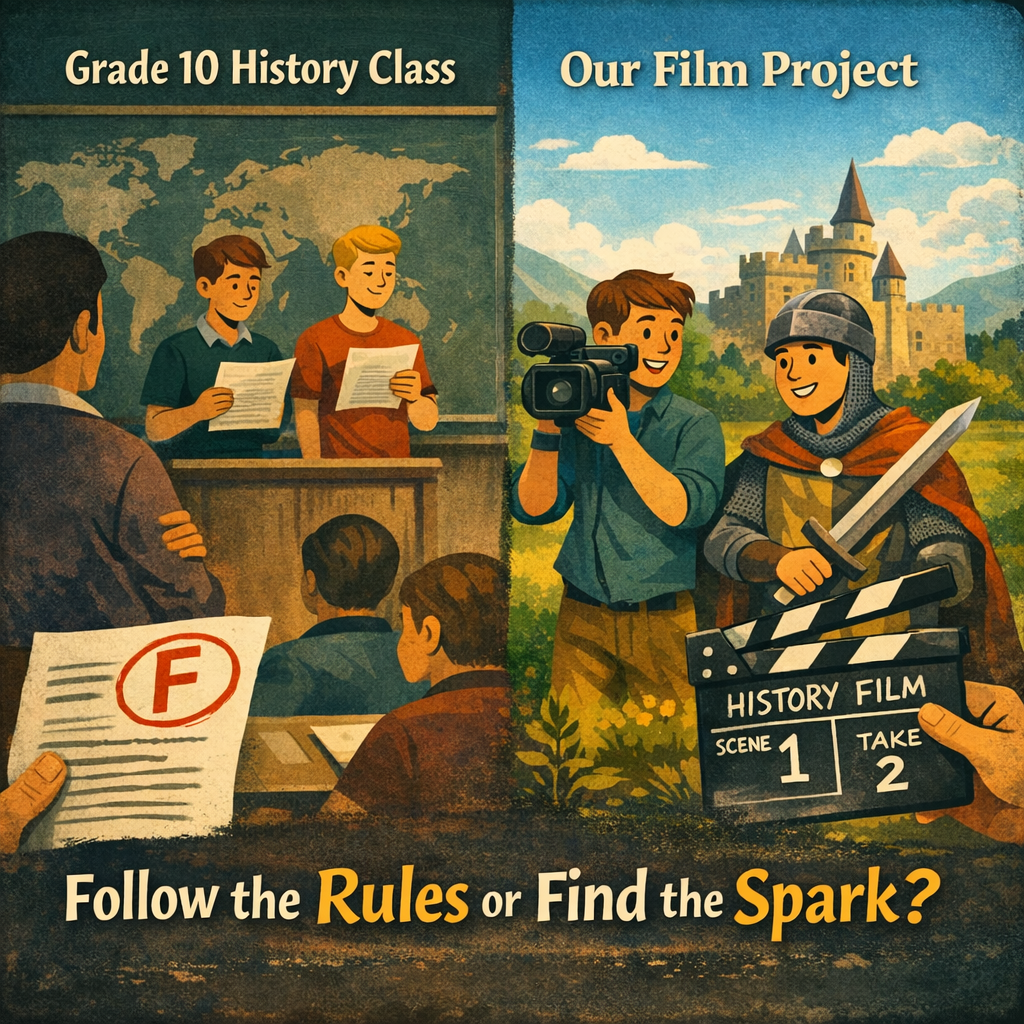
Grade 10. History class. My friend Seth and I were assigned a presentation — the standard kind: stand at the front, read from an essay, sit down. Instead, we made a short film. We covered the content, hit every requirement, and made something the class actually wanted to watch. The teacher failed us for not following directions.
I’ve thought about that moment more times than I can count. Not because of the grade, but because of what it revealed: that the system could look a student in the eye, watch them do something genuinely good, and call it wrong. That the form mattered more than the learning. I didn’t have the language for it at fourteen. I do now.
Twenty years of teaching gave me the other side of it. I’ve watched students come alive in class discussions, in projects, in anything where they can think and express and make — and then go completely flat when a test arrives and asks them to recall facts in a fixed format. The light goes out. Every teacher knows that face. Most of us hate it. Most of us do it anyway, because the system asks us to.
Pathways is my attempt to stop doing it anyway.
Why is a school like Pathways needed now?
Because the world our children are growing into is changing faster than the model of school most of us inherited.
The World Economic Forum projects that by 2030, 22% of today’s jobs will be disrupted — 92 million roles displaced, 170 million new ones created. In that same report, employers estimate that 39% of workers’ core skills will need to change within five years. What they’re asking for isn’t more subject knowledge. It’s creative thinking, resilience, agility, and the capacity to keep learning. Meanwhile, US Bureau of Labor Statistics data shows that people born in the late 1950s held an average of 12.7 jobs between the ages of 18 and 56 — nearly half of them before 25. That was before AI began accelerating the pace of change further still.
These aren’t abstract trends. They’re the conditions your child will live and work inside. The question is whether school is preparing them for that reality, or for a version of the world that no longer exists.
For me, those numbers point to a simple conclusion: the old model is no longer enough.
If the future demands adaptability, initiative, collaboration, self-awareness, and the ability to keep learning, then school cannot remain a place where students mostly sit still, absorb information, and prove short-term recall. We need schools that feel more like life itself — places where young people learn by doing, making, reflecting, discussing, solving, building, revising, and contributing.
That is the heart of Pathways.
What we are actually building
We are not building a school around the narrow question of how to move students efficiently through exams and into the next box. We are building a school around the larger and more urgent question of how to help them become adaptable, thoughtful, self-aware, and ready for a future none of us can fully predict.
That means meaningful interdisciplinary projects. It means real-world problem solving. It means internships, mentorships, presentations, collaboration, and feedback. It means helping students learn how to learn. It means giving them time and structure to notice what energises them, what kind of work matters to them, and what kind of life they want to build.
It also means creating a school that is intentionally human.
I want young people spending time outdoors, working with their hands, engaging in conversation, wrestling with ideas, testing themselves in authentic conditions, and building confidence through doing. I want school to feel connected to the world, not sealed off from it. I want students to experience their education not as a waiting room for life, but as life already underway.
As a parent, I want a school where my own children would be known well, challenged meaningfully, and prepared for a world that asks for both competence and character. As an educator, I want a school that takes seriously the realities in front of us: AI, shifting careers, ecological instability, and the growing sense many families feel that the old script no longer works.
Too many students spend their most formative years in systems that feel detached from life as it is actually lived. Pathways is my attempt to answer that honestly.
Where we are — and how you can help
What began as a question is now a structure. The philosophy is clear. The framework is concrete. The legal entity is registered. The accreditation process has begun. We are in active conversation about land. The bones are there, and the build is underway.
What we need now is people.
If this resonates with you, the most useful thing you can do right now is simple: subscribe to this newsletter if you haven’t already, and forward this post to one family who you think should know this school exists. One family. That’s it. Word of mouth is how schools like this find their first cohort.
If you’re in a position to do more — as a donor, as a founding family, or as someone with connections to land, funding, or aligned organisations in education — I would love to hear from you directly. You can reach me at rob@thepathwaysschool.org or through the website.
Pathways started as a calling. It is now becoming a school. With the right support, it can become a place where young people do more than prepare for the future.
They learn how to meet it.
Warmly,
Rob
About Rob & The Pathways School
Rob Wilson is an educator, writer, and father of two with over 20 years of experience in international, progressive, and experiential education. From rural Maine to Hong Kong, and now Spain, his journey has always revolved around one question: how can we help young people learn in ways that are meaningful, joyful, and truly prepare them for the future?
Born out of this question, The Pathways School is Rob’s answer. Launching in Southern Spain in 2027, Pathways is a high school that blends personalized, project-based learning with real-world readiness and ecological living. At Pathways, students design their own educational journeys—with the guidance of mentors, experts, and peers—rooted in curiosity, purpose, and deep connection to the world around them.
To follow the journey or get involved, subscribe to the blog or reach out. Let’s build something better—together.