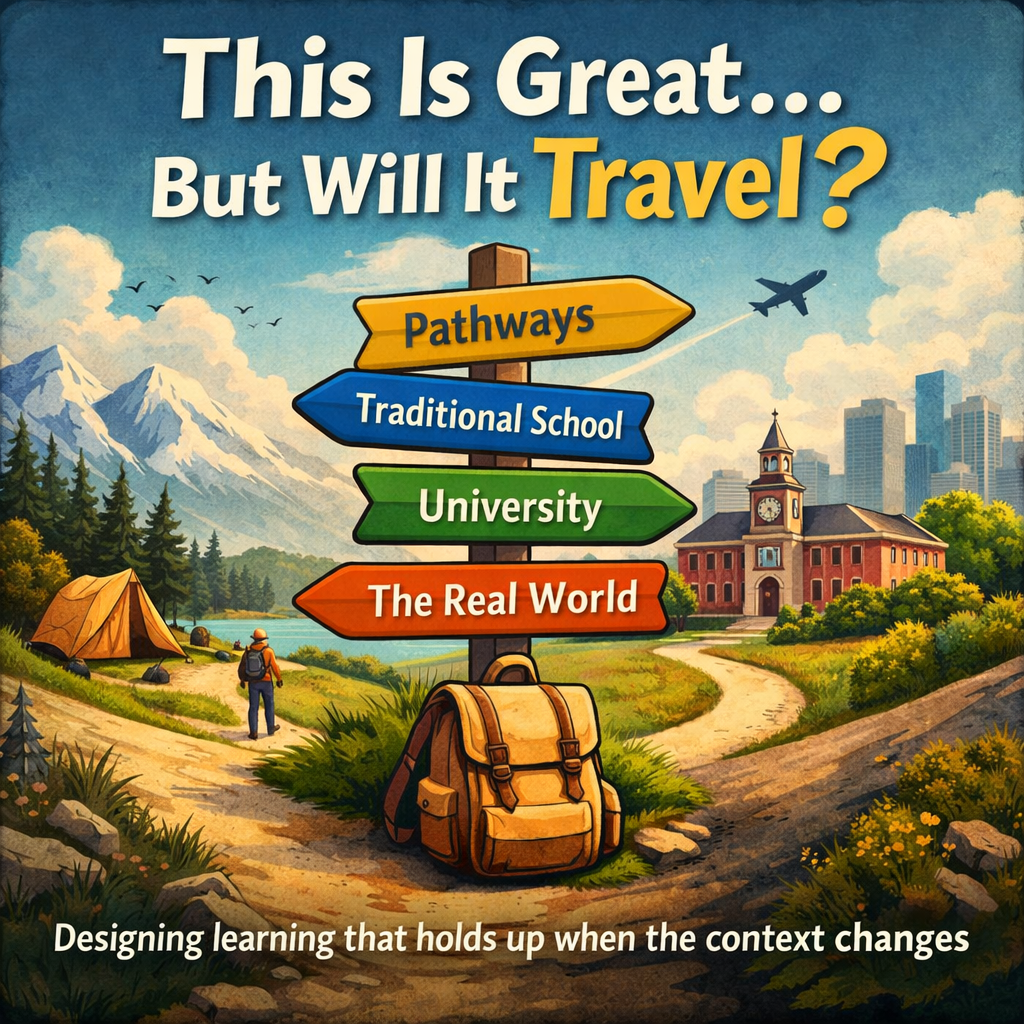
This is Great… But Will It Travel?
What actually prepares students for what comes next.
I was catching up with a parent the other day when they asked me the question that sits at the heart of every alternative education project:
“How prepared are these kids for the ‘real’ world? If they transition to a traditional, rigorous secondary school or a high-pressure university, are they going to keep up?”
Essentially: this is all wonderful, but will it travel?
It’s a fair question. Having spent years in high-performing secondary schools where grades were the only currency that mattered, I’ve seen the “rigor” trap up close. But the truth is, we often confuse compliance with readiness.
When we talk about whether an education “travels,” we aren’t talking about whether a student has memorized a specific syllabus. We’re talking about adaptive resilience.
The Skills That Survive the Trip
There is a specific set of “portable” skills that don’t just survive a change in environment—they compound over time. These are the traits that universities and employers quietly crave, even if they don’t always know how to test for them:
Learning how to learn: Knowing what to do when you don’t know what to do.
Self-directed work habits: The ability to move without a teacher hovering over your shoulder.
Comfort in the unfamiliar: Seeing a new challenge as a puzzle, not a threat.
Metacognition: The ability to step back and analyze your own thinking.
The Science of the “Dry Sponge”
Between the ages of 10 and 16, the brain goes through its second massive “renovation.” The prefrontal cortex is effectively being rewired—pruning away what isn’t used and strengthening what is.
During this window, students’ brains are like dry sponges. They aren’t just seeking facts; they are seeking a backbone of learned skills. If we spend this entire developmental stage teaching them only how to follow instructions, we miss the chance to hardwire the ability to think independently.
What the Research Says
We don’t have to guess if this works; the data is pretty clear.
In a landmark study led by John Dunlosky, researchers found that metacognitive strategies (like self-monitoring and adjusting your own plan) consistently outperform “content drilling” when students move into new academic environments. Basically, the kids who know how to monitor their own understanding perform better in unfamiliar settings than the kids who just memorized the textbook.
This is backed up by the National Academies of Sciences in their foundational text, How People Learn. They found that “transfer”—the ability to take what you learned in one place and use it in another—depends on deep conceptual understanding rather than surface-level procedures.
Even John Hattie, who famously analyzed over 800 meta-analyses on achievement, found that “self-reported grades” and “feedback literacy” (the ability to take a critique and pivot) are among the highest-impact factors for long-term success.
The takeaway? Learning how to learn beats curriculum alignment every single time.
Help Us Open the Doors
At The Pathways School, we aren’t trying to build a niche alternative. We’re building a small, carefully designed secondary school that prepares young people to move confidently between worlds, academic, creative, and practical alike.
That kind of education doesn’t happen by accident. It takes time, intention, and the right physical space to bring it to life.
We’re currently raising seed funding to secure our first permanent home and begin building the learning environments that Pathways is designed around. This early support will directly shape what’s possible for the students who come through our doors in the years ahead.
If this vision resonates with you, whether as a parent, educator, or supporter of future-ready education, there are several ways to get involved. Some families choose to contribute financially. Others start with a conversation.
How you can help:
Join the Conversation: [Book a call with Rob] to explore partnership.
Spread the Vision: Share this post with a family looking for “something better.”
Invest in the Future: [Link to funding page].
Warmly,
Rob
About Rob & The Pathways School
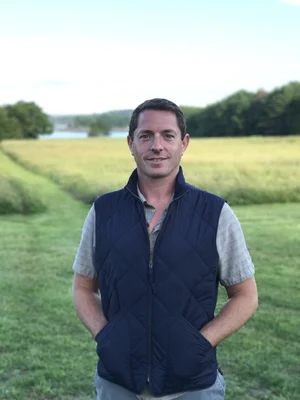
Rob Wilson is an educator, writer, and father of two with over 20 years of experience in international, progressive, and experiential education. From rural Maine to Hong Kong, and now Spain, his journey has always revolved around one question: how can we help young people learn in ways that are meaningful, joyful, and truly prepare them for the future?
Born out of this question, The Pathways School is Rob’s answer. Launching in Southern Spain in 2027, Pathways is a high school that blends personalized, project-based learning with real-world readiness and ecological living. At Pathways, students design their own educational journeys—with the guidance of mentors, experts, and peers—rooted in curiosity, purpose, and deep connection to the world around them.
To follow the journey or get involved, subscribe to the blog or reach out. Let’s build something better—together.